
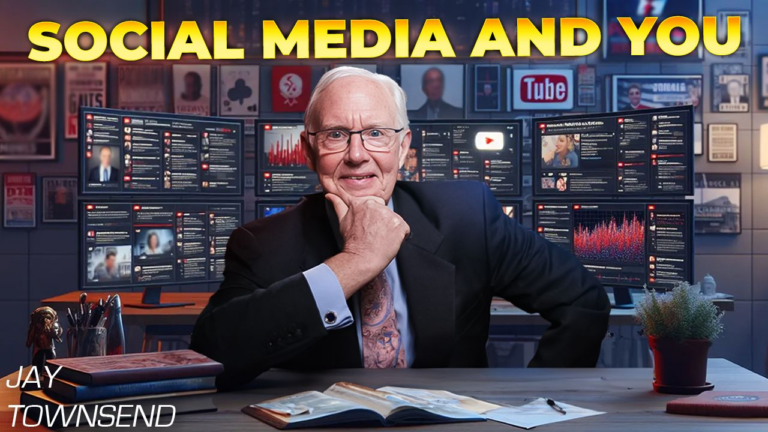
Every generation of candidates has ridden a new technology to power — newspapers, radio, television, cable, Facebook. In this video, political consultant Jay Townsend explains how social media has changed political campaigns, the human emotions every effective post is designed to trigger, and how to use each major platform to reach different slices of the electorate.
In this video, we’re going to talk about how social media is used in political campaigns. Here’s the short answer: it’s used to influence voters and the way they behave. If you want to know how to actually use it — whether to help someone running for office or to run yourself — stick with me, because to know how to use it, you have to understand its history and its special uses.
Technology in politics isn’t new. In 1860, the new technology was newspapers, and Abraham Lincoln used them in his campaign for president. Roosevelt was the first to master radio, and he was elected four times because of it. John Kennedy became president because he mastered television. Bill Clinton mastered cable television and the internet. Barack Obama was the first to master Facebook. Every one of these candidates rose to power using what was then new technology. Today, social media is that new technology, and somebody is going to win an election this year because of how skillfully they use it.
Social media differs from past political technology in a couple of key ways. First, unlike past technology, it’s very easy to find like-minded people and build tribes around a particular issue, movement, or cause — there was no two-way communication with the technologies that came before it.
Second, the sources of information have changed completely. There was a time when most Americans got their news by watching Walter Cronkite on the CBS Evening News — he was the country’s main source of daily news, with no feedback, no commentary, no real criticism of what he chose to cover. Today there’s no single source of news capable of swaying an election the way Cronkite once could. News now comes from all directions — someone sitting in their basement can say something pithy, get attention, and watch it spread across social media. That has completely changed the back-and-forth of how we communicate about politics.
How it’s used is also very different because of how easily it’s done. Social media is used to cajole, to convince, to influence, and sometimes to repulse people about certain subjects. The secret to using it well is understanding how your posts trigger one of seven human emotions: fear, anger, sadness, disgust, contempt, surprise, or happiness — another word for hope.
If your posts trigger any one of those seven emotions during a campaign, you’ll get feedback, commentary, and shares. So before you post anything, ask yourself: what am I trying to trigger here, and what do I want people to do as a result? Look for a way to trigger an emotion
.
Words are still the most powerful drug humankind has ever known, but words combined with other tools make them even more powerful. Start with words, then add words in a video, words set to a music track, words on a picture, words in a meme, words on an image. Combining words with a picture, video, or meme communicates far more than words alone ever did in a newspaper — and doing that adroitly, in a way that triggers human emotion, is how it’s done.
There are many social media tools available today, but I’ll mention the big six. Facebook is still dominant, and it also owns Instagram, which plenty of people still use. YouTube is one of the newer, but now enormously influential, tools in politics. TikTok reaches younger voters. Twitter has a very specialized audience. And LinkedIn is increasingly being used to influence politics.
Here’s the point: if you’re trying to reach a broad slice of the electorate, you can’t rely on just one platform. TikTok alone won’t reach grandma and grandpa — they’re more likely on Facebook. If you ignore YouTube while trying to reach middle-aged voters, you’ll miss them, since that’s where a lot of their political information comes from. To successfully run a political campaign on social media and reach a wide swath of the electorate, you have to meet people where they are — which means using all of these platforms together.
How you use social media is ultimately up to you. It can be used for good, and it can be used for evil. It has already been a route to power for people, and going forward it’s going to carry even more people into office. Here’s a piece of knowledge from a lifetime of reading history: the people we regard as heroes today, the iconic figures of our past, aren’t remembered fondly for the hate they spewed, the division they sowed, or how they tried to pit people against each other over skin color, accent, language, or religion. Those who rose to power that way are not remembered well, and never will be.
The people who used technology for good are the ones remembered — those who used it to bring some measure of freedom to people who had none, to feed the hungry, to build housing for those without it, to bring clean water and sanitation to places that never had it, to give people hope. I once heard a governor talk about what unites all religions: the question of what we can do during our short time on earth to make the experience of living here as good as possible for others. That power is at your fingertips with social media. How you use it is up to you — but it’s my hope you’ll use it for good, because in the end, the only thing you ever take to your grave is your reputation.
Q: How has technology historically shaped political campaigns?
A: Every generation of political power has been built on a new communication technology — Lincoln with newspapers in 1860, Roosevelt with radio, Kennedy with television, Clinton with cable and the internet, and Obama with Facebook. Social media is simply the latest technology candidates are learning to master.
Q: What makes social media different from earlier political technology like TV or radio?
A: Social media enables two-way communication and lets like-minded people easily find each other and form tribes around a cause — something older, one-way technologies like radio and network news never allowed. It also decentralizes news, so no single figure can shape opinion the way a single news anchor once could.
Q: What emotions do effective political social media posts try to trigger?
A: Seven human emotions drive engagement: fear, anger, sadness, disgust, contempt, surprise, and happiness or hope. Posts that successfully tap into one of these emotions generate feedback, commentary, and shares, which is why it helps to ask what emotion you’re trying to trigger before you post.
Q: Which social media platforms matter most in a political campaign?
A: The six most influential platforms are Facebook (which also owns Instagram), YouTube, TikTok, Twitter, and LinkedIn. Each reaches a different demographic — TikTok skews younger, Facebook reaches older voters, YouTube reaches a broad middle-aged audience — so campaigns trying to reach a wide electorate need to use several platforms together rather than relying on just one.
Q: Is social media good or bad for political campaigns?
A: It’s a tool, and its impact depends entirely on how it’s used. Historically, the political figures remembered fondly are those who used communication technology to help people — providing freedom, food, housing, clean water — rather than to spread division. That history is worth keeping in mind when deciding how to use social media in your own campaign.
Jay Townsend has spent more than 40 years advising candidates at every level of American politics. Browse the full library of free campaign resources at JayTownsend.com or subscribe to Jay’s YouTube channel for new videos every week.
Copyright @ 2026 jaytownsend.com, All Rights Reserved.