
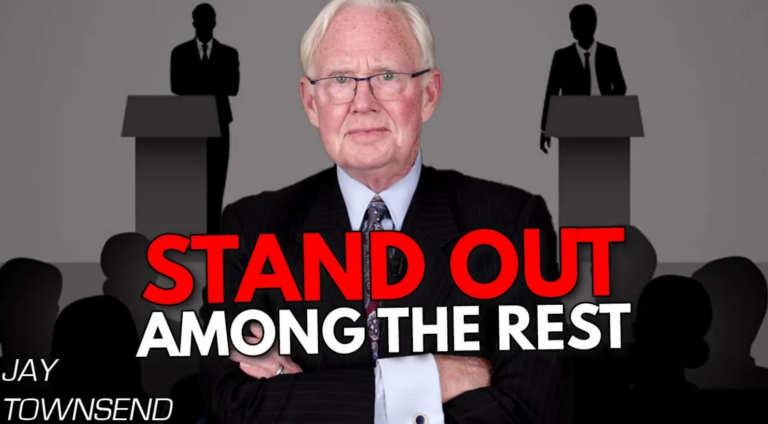
Some candidates spend a fortune and lose; others spend far less and win. In this video, political consultant Jay Townsend breaks down why: the strength of your campaign message. He walks through the five components every effective message needs — your story, your moral code, the problems you’ll solve, your qualifications, and what makes you different from everyone else running.
In this video, we’re going to talk about how to create a campaign message. Why do candidates who spend a fortune sometimes lose, while candidates who spend a lot less win? The answer is the strength of their message. Your campaign message has five key components, and in this video I’m going to explain what they are and how you build yours: what are your qualifications, what is your moral code, what problems are you going to solve, what story are you going to tell, and what makes you different.
The first, and frankly sometimes the most important, is the story you tell that explains why you’re running. Here’s the truth: voters are inherently distrustful of people who run for public office. They’re cynical, quick to regard candidates as crooks, thieves, grifters, and clowns. It’s now incumbent on almost every candidate to use words or an episode from their life that demonstrates to voters they’re running for the right reasons — not just to see their face on cable TV every night.
Let me share a story I developed for another candidate to illustrate this. A young man running for the Senate in a Midwestern state had called me, and we were talking about what he’d say in his campaign video. I felt I needed to go through his life history to help him articulate his story, and out of the blue I asked, “What’s your earliest memory of anything?” He said it happened when he was two: cold water up over his butt, in the dark, in the Mekong River, tied to a rope with his grandparents behind him and his parents in front.
His father had sided with the Americans during the Vietnam War while living as a farmer in Laos. When the Communists took over, anyone who’d helped the Americans was being hunted down, their farms burned. So one night, his father decided it was time to go. They left everything behind and walked for three days and three nights through the jungles of Laos to reach the Mekong River. In the pitch dark, around three in the morning, his father pointed to the lights of freedom across the water, and they crossed. On the other side was a refugee camp holding 70,000 people, where the family lived in total poverty for seven years.
Eventually, a man came to see his father and told him he’d been offered the chance to move to the United States. The candidate remembered his first day here vividly — the first time he’d ever seen a flushing toilet, his first taste of Coke, his first car ride, during which he threw up all over his mother. When I asked what any of this had to do with the voters in his state, he said, “Jay, every freedom I enjoy, every dollar I have, everything I am, I owe to the United States of America, including my college degree. That’s why I’m running for the Senate. We have to make this democracy work. America is too important to the rest of the world to waste this, and the last thing I ever want is to see clowns ruin our democracy in Washington.”
That became his signature story. No one doubted his sincerity about why he was running for the U.S. Senate. That’s what a compelling story looks like — something that happened in your life, something you saw or heard that altered how you think about the world or your community, that fundamentally shaped your journey. If you can find a story like that, it’s gold.
The second part of your campaign message is what I call your moral code. Voters need to know that your fundamental beliefs — your view of what matters in this world — are in sync with theirs. You should tell voters something about your moral code, because otherwise they’ll sense something is missing, and they won’t figure out what until it’s too late for you to explain.
We all have a moral code: certain things strike us as absolutely wrong, and we think, how could people be that evil — people who steal money from innocent people, for instance. Those are your fundamental notions of right and wrong, good and evil. Have you volunteered for a charitable cause? That says you care about the people on the receiving end. Do you go to church? That says something about your religious beliefs and the community you care about. I don’t care exactly what you tell voters, but I believe this should be part of your campaign message.
Third, and important in a lot of ways: voters really don’t care about you. They care mostly about what you’re going to do for them. That’s a hard thing for candidates to hear, but it’s true. In your campaign message, you have to tell voters what you’ll fight for — what policies you’ll try to pass or change, what problems you’ll fix, what wrongs you’ll right, what injustice you’ll correct, what group of people you think needs to be lifted up, and where you stand on causes like advancing civil rights.
This needs to be part of your campaign message, because if voters have no idea why you’re running or what you want to do, they’ll assume you are only in it for yourself.
The fourth component is what makes you qualified. Here’s what voters actually want to know: they don’t want your whole resume, and they don’t care about your entire life story. They just want to know that you’ve got your feet on the ground — that you’ve done something useful, that you’re not a clown, a crook, a grifter, or a liar running for the wrong reasons.
So how do you answer that for voters? Tell them things you’ve done in your life that demonstrate you’re grounded: Are you married? Do you have kids? Have you served in a charitable organization? Have you held a job, and done something notable in it? Have you served in the military? Have you written a book? Something about your life that shows you’ve lived an exemplary life.
The fifth thing I’ll mention is what marketers call a unique selling proposition — what makes you different. It’s a marvelous way in a political campaign to separate yourself from your competitors in a way voters find appealing. What you are for that no one else is.
Part of building your message involves studying your opponents — look at their bios, their issue positions, what they say on their website — and pick out what makes you stand apart. Are you the only one who’s served in the military? The only one who’s started a business, met a payroll, or balanced a budget? The only one who rose from the lowest rung at your company to senior management? Give voters something that makes you different, and advertise it. It’s no more complicated than what Juicy Fruit does on the shelf at the grocery store — look closely, and you won’t find any other gum with that yellow label. That’s their unique selling proposition, and you have one too.
Q: What are the five components of a strong campaign message?
A: A strong campaign message includes your personal story (why you’re really running), your moral code (your fundamental values), what you’ll do for voters (the problems you’ll solve), your qualifications (proof you’ve got your feet on the ground), and your unique selling proposition (what makes you different from every other candidate).
Q: Why is a personal story so important in a campaign message?
A: Voters are naturally distrustful of candidates and quick to assume the worst about their motives. A genuine, specific story from your life — something that shaped how you see the world — proves your sincerity in a way that policy talking points never can.
Q: Do I need to explicitly state my moral code to voters?
A: Not necessarily in so many words, but voters need to sense that your fundamental values align with theirs. Actions like volunteering, church involvement, or community service communicate your moral code even without a direct statement.
Q: What do voters actually want to know about my qualifications?
A: Not your full resume. They want reassurance that you’re grounded and credible — things like your family life, work history, military service, or accomplishments that prove you’re not a fraud or an embarrassment waiting to happen.
Q: How do I find my unique selling proposition as a candidate?
A: Study your opponents’ bios, issue positions, and websites, then identify what only you can claim — whether that’s military service, business experience, a specific policy commitment, or a personal achievement none of your competitors share.
Jay Townsend has spent more than 40 years advising candidates at every level of American politics. Browse the full library of free campaign resources at JayTownsend.com or subscribe to Jay’s YouTube channel for new videos every week.
Copyright @ 2026 jaytownsend.com, All Rights Reserved.