
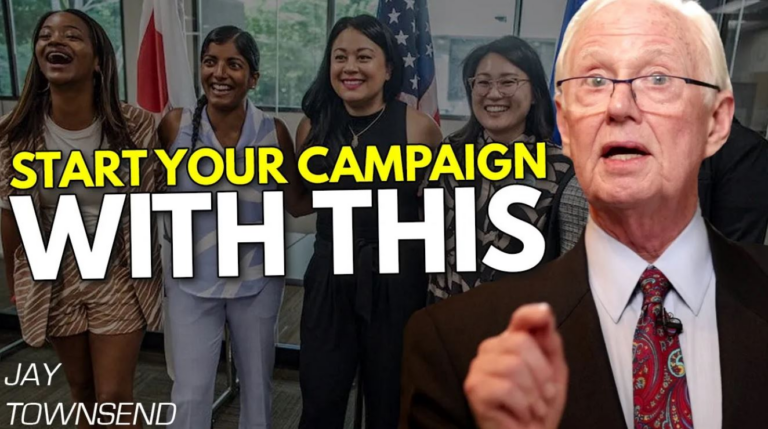
Running for state representative is one of the most direct ways to shape the laws and policies that affect people in your community — but winning requires a lot more than good intentions. In this blog post, political consultant Jay Townsend walks you through exactly what it takes: how to build a network of supporters, how to study your district, how to craft a message voters will respond to, and how to put together an advertising plan and budget that can actually get you elected.
We’re going to talk about how to run for state representative. If you’ve ever thought about doing that, please stay with me and read this entire post, because I have some invaluable information to share with you about what you need to know and how you win an election.
Here’s what we’re going to cover: how to develop a powerful network of energetic volunteers and stout supporters; how to craft a campaign message; how to study your jurisdiction so that you’re running a smart campaign; how to disseminate that message to the people who need to hear it; and how to raise the money to pay for your advertising plan.
You need a strong network of two kinds of people to get a campaign for state representative off the ground. The first source is your own existing relationships. Chances are you’ve been active in your community, or you know people who have been. So take inventory: family, close friends, relatives who live nearby, people you’ve met through civic and charitable organizations where you’ve served, people you’ve encountered through jobs you’ve held. Write them down.
If you can’t think of all the people you know, there are three places to check. First, your mobile contact list. Scroll through it and look for people whose faces you’d recognize if you met them on the street, or whose voice you’d know the moment they said hello — people who, if you called them to ask for help with your campaign, would immediately know who was calling. Second, your Facebook friends list. If you’ve had an account for a while, you’ve probably connected with people who go way back — people who might contribute to your campaign or, if they live near you, might be willing to go door to door with your literature. Third, your LinkedIn connections. The people on that list are often opinion leaders or professionals with influence in their field, and that influence can be very helpful to you.
There is a secondary network that is essential in a political campaign. Most state representative candidates run as a Republican or Democrat, which means there is a party apparatus in your district — elected leadership, a structure, stakeholders. If you can solicit and secure their support, it will help you get your name on the ballot and run a credible campaign. You don’t have to have it, but it’s a lot harder to win without party leaders in your corner.
The second group to cultivate is elected officials in your jurisdiction who belong to your party. Keep this in mind: if they already hold elected office, they’ve been through a campaign. They’ve done advertising. They’ve won. They have a much better idea how to do this than a first-time candidate does. Securing their endorsement is a meaningful early advantage.
Third, target civic and community leaders in your jurisdiction who need — or want — a good relationship with their state representative. Think about board members of organizations like the United Way, which serves people who can’t otherwise find help. Think about the head of your Chamber of Commerce. Think about the leaders of ethnic communities in your district, and people outside the district whose voice carries weight inside it. The more of this network you build before you launch, the easier the campaign will be. Trying to build it halfway through, when time is scarce, is much harder.
You really do need to know a lot about your jurisdiction — and not just where people live. You need to study past turnout patterns to get an idea of how many people are expected to vote in the race you’re running. You need to understand the partisan identification of the electorate to properly plan a campaign.
And if you can get your hands on demographic data, it comes in very handy. Look at the age brackets of people in your district — does it skew young or old? Look at income levels — is it an upper-class, middle-class, or lower-income area? Look at the racial and ethnic composition of your district, because that helps you plan outreach. Look at education levels, because people with college degrees tend to vote somewhat differently than those without. If you’re having trouble finding this information for your specific jurisdiction, please be in touch and I’ll point you to a place where you can easily find it. https://jaytownsend.com/contact/
The third essential component of your campaign is your message. You are asking people to give you power. As a state representative, you’ll be voting on a state budget — deciding how that money is distributed to school districts, to people in need, to health care, to the bureaucracy that keeps state government running. Voters are going to expect you to tell them something meaningful: what problems you’re going to fix, what inequities you’re going to address, what injustices you want to correct, what policy initiatives you’ll push for in the legislature. That is the core of your message — and it’s your answer when a voter asks, “Why do you want this job?”
There are other components of a good campaign message, too. Voters need to know that you have your feet on the ground — that you’ve done real things in your life that qualify you to cast votes affecting the justice system, state finances, and everything else legislators decide. Convey your values, sometimes through pictures: a photo of you serving veterans, a photo of you reading to children. Images like those tell voters your priorities match theirs without you having to say it directly.
Voters today are deeply cynical about anyone seeking office. They assume candidates just want to see their name in the paper. So if there’s a story in your life — something that made you passionate about fixing a particular problem, something that brought you to this race specifically — tell it. A personal story makes it easier for voters to trust you with a decision that affects their lives.
Finally, in almost every race you will face an opponent — in a primary, a general election, or both. Voters appreciate it when you make the choice simple and clear. Give them a reason to choose you over the other candidate.
Unless you plan to knock on every door in your jurisdiction, you’ll need paid advertising at some point. If your district has 50,000 or 60,000 doors, it would take months, if not a year, to knock on all of them. So what are your options?
Social media is a good starting point — you can post there for free, and both Facebook and YouTube offer inexpensive paid advertising that lets you target the specific voters you need to reach. Digital advertising is another powerful tool: those ads you see when you open a news site on your phone are purchased by campaigns, and the firms that run them can target down to specific neighborhoods and streets. Persuasion mail — physical mailers with photos and words that reinforce your brand and explain your qualifications — is a staple of campaigns at this level. In some markets, connected TV or cable television advertising can also be useful, though commercial broadcast TV is rarely within reach for a state representative race.
Once you know what advertising you need, build a budget around it. Add in your other campaign costs — staff, a headquarters if you need one, volunteer support, food for volunteers working long hours. Now you have a campaign budget. Follow it. Don’t spend too much early, because candidates who do typically run out of money at the end, when it matters most.
As for raising the money to fund that budget, there are several ways to do it. You can send text messages or emails to your list asking for contributions. You can call your family, friends, relatives, and opinion leaders directly and ask them to contribute — a personal ask is more effective than most people expect. You can ask a well-connected friend to collect donations on your behalf through surrogate fundraising. You can send fundraising letters by mail. You can organize events: small cocktail parties or neighborhood gatherings where a friend invites fifteen or twenty people who each give a modest amount at the door. For larger donations, a dinner party with five well-heeled couples and a direct ask can be very productive. And for maximum impact, consider a celebrity event — invite a notable speaker, author, or recognized figure, charge an admission price, put them on stage, and let them draw the crowd for you.
Q: How many people do I need in my supporter network before I announce my candidacy?
A: There’s no magic number, but the goal is to have enough committed volunteers and donors lined up that you can hit the ground running on day one. At minimum, you want to know you can staff a launch event, fund your first few weeks of advertising, and have people willing to go door to door. Launching without that foundation is one of the most common and costly mistakes first-time candidates make.
Q: Where do I find demographic data on my state legislative district?
A: The U.S. Census Bureau’s data tool (data.census.gov) is a good starting point for population, income, education, and racial demographics. Your state’s Secretary of State or Board of Elections website typically has voter registration totals and past election results broken down by district. Your state party organization may also have more detailed targeting data available to candidates running under their banner.
Q: How much money does it typically cost to run for state representative?
A: It varies enormously by state and district size — a rural state house race might be winnable for $10,000–$25,000, while a competitive suburban district in a large state can require $100,000 or more. Research recent winning candidates in your specific district to understand what was actually spent. Your state’s campaign finance disclosure website will have this data.
Q: What is persuasion mail and why is it still effective?
A: Persuasion mail is a physical mailer — typically a postcard or folded piece — sent to targeted households with images and copy designed to introduce you, communicate your qualifications, and reinforce your message. Unlike digital ads, physical mail gets handled by the voter directly and has no algorithm to compete with. It’s particularly effective for reaching older voters who are high-propensity but less reachable through social media.
Q: How do I ask someone to donate to my campaign without it feeling awkward?
A: The most effective fundraising ask is personal, specific, and brief: tell them why you’re running, what you’re trying to accomplish, and exactly what you’re asking for. Most people are not offended by a direct ask from someone they respect — they’re offended by vague appeals or being treated as a transaction. If you’ve built genuine relationships over time, the ask is a natural extension of those relationships, not an imposition.
Jay Townsend has spent more than 40 years advising candidates at every level of American politics. For more campaign strategy resources, visit JayTownsend.com or subscribe to Jay’s YouTube channel for new videos every week.
Copyright @ 2026 jaytownsend.com, All Rights Reserved.