
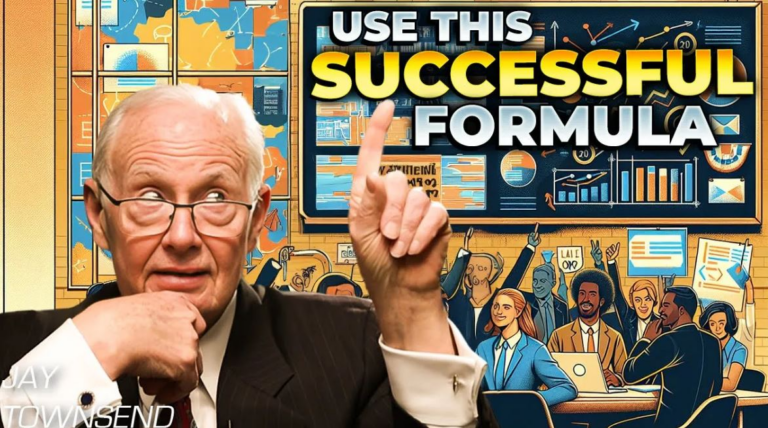
Winning a political campaign comes down to two things — and if either one is flawed, you lose. In this video, political consultant Jay Townsend lays out the complete framework: how to build a campaign message that answers every question voters are silently asking, how to get that message in front of the right people through advertising, how to raise the money to pay for it, and why getting help is one of the smartest decisions a first-time candidate can make.
Here are two essentials of success in politics, in winning a political campaign. Number one, you need a compelling message. Number two, you have to figure out how to disseminate that message through advertising. If you have a compelling message and you do a good job of getting it out there, you win. If either one of those is flawed, you will not. We’re going to spend the bulk of our time on both because they are critically important to your success.
Let me run an experiment. I’m going to pretend I’m a voter, and I’m going to ask you the five questions that voters will expect you to answer during the course of your campaign.
One: What makes you qualified? Two: What are your notions of right and wrong, good and evil — how do I know your values are in sync with mine? Three: What are you going to do for me, for my family, for our community or our state — what are you going to do with the job if you get it? Four: How do I know I can trust you — how do I know you’re going to do what you promise when I’m not looking? Five: What makes you better than the person running against you? Those five questions are your campaign message. Your job in a campaign is to come up with the answers.
What you’re going to do for voters is probably the most important piece of your message. That’s where you talk about how you’re going to use the power that you are asking voters to give you. How you’re going to improve their quality of life. How you’ll make it easier to get a job, give a struggling section of your electorate a hand up, keep taxes down, put more money in people’s pockets, increase wages, or bring more jobs to your community. The world is your oyster when it comes to what you want to fight for — but it must be relevant to the voters you’re appealing to, because they will expect it to be.
When it comes to your qualifications, voters don’t need your whole résumé. They don’t need every place you’ve ever lived or every trophy on your shelf. They just need enough to know that you’ve got your feet on the ground, that you’re smart enough to make judgments on their behalf, and that you’re capable of doing the job.
As for your values — voters want to know that what disgusts you disgusts them, too. If you live in a community where faith matters and you’re a churchgoing person, mention it. If you care about poor people and your constituents do too, talk about the community organizations you’ve served. A photo of you on a couch reading to two young children says something about your values without you having to state it explicitly. A picture of you serving food to veterans signals where your heart is. You are responsible for communicating your moral code to voters — they won’t assume it.
Trust is often built through story. If you’re thinking about running for office, I already know something about you that you may not know about yourself: something in your life profoundly affected you and planted a political seed that is now germinating. At some point — something you saw, something you heard, something you experienced — planted that seed. It may have been witnessing an injustice, some act of cruelty that infuriated you, some moment where a problem didn’t get fixed that should have been. You now seek the power to fix it. Can you tell that story? Can you talk about what that problem is, and how the power of the office would help you address it? If you can tell a story like that correctly, voters will never doubt your motivation for running.
Finally, why you and not your opponent? You don’t have to be nasty about it, but at the end of the day, you will have differences with the person running against you. Tell voters what they get from you that they’ll never get from your opponent. Tell them the things you’ll fight for that your opponent won’t. Tell them the improvements to their quality of life that aren’t even on your opponent’s radar. That’s what we call the “why you, not them” component of a campaign message, and it needs to be part of what you’re saying by the end of the race.
The second major question is: how do you advertise your message? Good news — some of the best methods cost little or nothing. If you’re running in a small jurisdiction where you can win with fewer than 3,000 votes, the most effective advertising you can do is to print a handout or palm card and go knock on doors. Engage people in your jurisdiction one on one. When you get home at night after talking with twenty people, sit down and write each of them a handwritten note thanking them for their time and including your cell phone number. If you do that consistently, they will vote for you. There is no paid advertising in a small race that beats that.
The trouble is, most candidates don’t have time to knock on more than 2,000-5,000 doors. They think they do, but between family, other obligations, and all the other demands of a campaign, the door count falls short. So this is where paid media enters the picture. Two to three posts a day on Facebook, regular activity on Instagram, TikTok for younger voters, YouTube videos, even LinkedIn for well-connected voters in your district — all of this organic social media activity is free and valuable. But at some point in a competitive race, you will have to bite the bullet and pay for advertising.
Facebook and YouTube paid advertising are the most efficient forms of political advertising available right now. They’re cheap, they’re targeted, and they put your face, your brand, and your message in front of the specific voters who need to see it. I recommend them for almost every campaign. Beyond that, digital advertising — the banner and pre-roll ads you see when you visit a news site on your phone — can be targeted down to specific neighborhoods, streets and households. Text messages and emails with links to your website are another option. In larger races, persuasion mail — direct mail pieces with pictures and a few well-chosen words — is often the single biggest advertising expense candidates carry, and for good reason: it reaches high-propensity voters precisely and predictably. Radio still works well in many markets, especially around talk programs in rural areas. And television — over-the-top, connected TV, cable, commercial broadcast — is very effective but it costs real money.
All of that advertising requires money. And money is a necessary ingredient of any political campaign you want to win — even a volunteer-driven one. Think about it: if volunteers spend a hot day knocking on doors for you and come back to headquarters with no food and nothing to drink, they may not come back tomorrow. At minimum, you owe them pizza and a soft drink. Treating your volunteers well costs money.
The lowest-hanging fruit — the easiest money you’ll raise — comes from people who already know you, like you, and consider you a friend or family member. Start by scrolling through your phone contacts and writing down the names of people who could write you a check or volunteer on your campaign. Then go through your Facebook friends — you’ll almost certainly find people you’ve lost touch with who would help if you asked. Then look through your LinkedIn connections, because many of those people are professionally connected and capable of contributing.
Beyond those personal networks, there are six more fundraising methods: surrogate fundraising (asking a well-connected supporter to collect donations on your behalf), direct mail fundraising, cocktail parties, neighborhood gatherings, high-end dinner parties, and celebrity events with a notable guest who draws an audience willing to pay to attend. All of these have been used successfully by candidates at every level.
Especially if you’re running for the first time: get some help. It doesn’t mean you’re not smart enough to figure this out on your own. What it means is that there are people in this world who do political campaigns day in and day out, year after year. They are current on the techniques, the technology, and the data. They know what a campaign message needs. They know where to find the information that tells you how to advertise. You are far better off paying them to tell you what’s best for your race than spending months trying to learn everything from scratch.
Here’s why that matters strategically: there are certain things only you can do in a political campaign. Only you can give the speech to the Rotary Club. Only you can stand on the debate stage. Only you can do the newspaper, radio, or TV interview. Only you can show up at the events where you are the guest of honor. Being the best version of yourself in all of those moments is essentially a full-time job — especially when you factor in family, faith, and the rest of your private life. The reason to get help is so you can delegate the tasks that others can handle, and pour everything you have into being the best candidate possible. That is how campaigns are won.
Q: Which of the five message elements is most important?
A: What you’re going to do for voters is the most important piece — it’s the answer to the question every voter is silently asking: “What’s in this for me and my family?” Everything else (your qualifications, your values, your personal story, why you’re better than your opponent) serves to make voters trust that you’ll actually follow through on your agenda. Get the agenda right first, then build the rest of the message around it.
Q: How do I figure out what issues to run on?
A: Start by studying your district — past turnout data, demographic composition, local news coverage, and the issues that have generated the most community engagement. Then layer in your own genuine concerns: what have you seen in your community that needs fixing? The strongest campaign messages live at the intersection of what voters already care about and what the candidate is authentically passionate about. Issues that feel forced or adopted for political convenience rarely land.
Q: How much money do I actually need to run a competitive race?
A: It depends entirely on the size of your district and the competitiveness of the race. The best benchmark is to look at what winning candidates in your specific race have spent in the last two or three cycles — your state’s campaign finance disclosure website will have this data. Use those figures as your target. Build your advertising plan first, then figure out how much you need to raise to fund it.
Q: Is door-knocking still worth doing in larger races?
A: Yes — but strategically. In a large district you can’t knock every door, so you target. Focus on high-propensity voters in competitive precincts: people who vote in most elections but whose support is genuinely up for grabs. A conversation at the door, followed by a handwritten note, is still one of the most persuasive things a candidate can do. Even if you only reach 1,000 voters this way in a race decided by 5,000 votes, those 1,000 relationships can be decisive.
Q: How do I find a good political consultant?
A: Ask elected officials in your party who they’ve used and trusted. Look for consultants who have won races at your level — a Senate campaign consultant may be overkill and too expensive for a state house race. Check their win-loss record and ask for references from past clients. You can also reach out directly to me — I set aside time each week specifically to talk with candidates who have questions. The first call is free.
Jay Townsend has spent more than 40 years advising candidates at every level of American politics. For more campaign strategy resources, visit JayTownsend.com or subscribe to Jay’s YouTube channel for new videos every week.
Copyright @ 2026 jaytownsend.com, All Rights Reserved.