
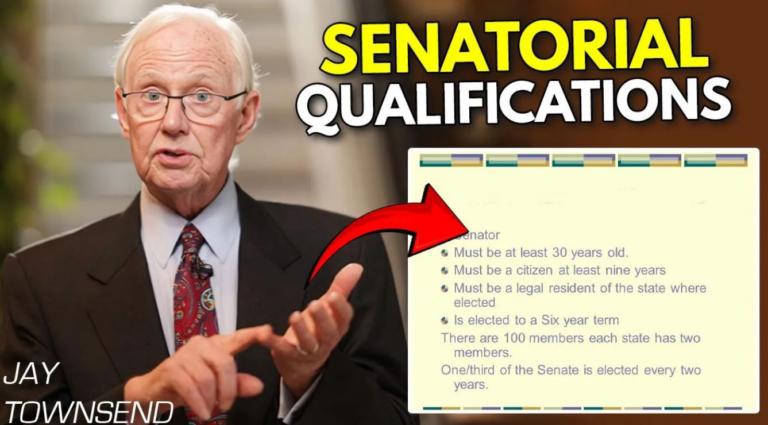
Few campaigns are more complicated than a U.S. Senate race. In this video, political consultant Jay Townsend breaks the process down into clear steps: understanding the power of the job, building your network, studying your state’s demographics, crafting your message, advertising it effectively, and budgeting and raising the money to fund it all.
In this video, we’re going to talk about how to run for the United States Senate. Few campaigns are more complicated than a Senate race, so let’s break it down into easy-to-follow steps: the nature of the job, how you develop a network that carries you through the campaign, how you study your state so you know the people who live there, how you craft a message that carries the day, how you advertise that message, and how you raise the money to pay for it all.
Let’s start with the job itself. You’re asking to become one of the 100 most powerful people who serve in Washington — there are only 100 senators in the United States. You’ll have say over the entire federal budget — where and how we spend trillions of dollars — influence over how that money is collected, influence over which countries receive U.S. aid, influence over criminal justice matters, and influence over which treaties get approved. If you have no idea what you want to do with that kind of power, take the time to learn the federal budget, including the difference between discretionary and entitlement spending, so that whenever someone asks what problem you want to fix, you have an answer that makes sense — whether you’re at a town meeting or knocking on doors.
Second, you need to be an expert on your state. Look at past turnout — how many people normally vote in the year you’re running — as a barometer for how many votes you’ll need to win. You also need the partisan affiliation of your state’s voters, along with a complete demographic profile: age brackets, the percentage of young versus old versus middle-aged, how many households have children, income levels, race and ethnicity, education levels, and the rural-versus-suburban-versus-urban mix.
If you don’t know these things, you’ll spend money on things that don’t matter, your message will get lost, and you won’t be able to micro-target the niche audiences you need to reach if you want the job of U.S. senator.
Next, you’ll need a strong network of supporters, and there are two kinds. The first is your personal network — people you know who have influence, who could be opinion leaders, or who could volunteer at your campaign headquarters. Inventory that network at the outset, because you will not become a U.S. senator without the help of a lot of other people.
If you don’t know your network offhand, there are three places to look: scroll through the contacts on your mobile phone and note who recognizes you and might help your campaign; go through your Facebook friends and look for those who are influential or whose opinion matters; and check your LinkedIn connections, since friends often show up there too.
There’s a secondary network that’s equally important in a Senate race. Every political party has a structure in every state — a state chair, a state executive committee, and county chairs affiliated with your party. They’re insulted if you don’t talk to them, court them, or nourish the relationship. You may be able to defeat them if they back somebody else, but your life will be a whole lot easier if at least some of them support your candidacy — and you’ll never get that support if you don’t go court them.
The second place to look for support is among elected officials of your party who already hold office, whether county commissioner or state senator. They’ve run and won an election, they have their own network of strong supporters and donors, and if they open up their contact lists to you, they can connect you with people who help your own campaign. They also tend to be opinion leaders whose endorsement carries real weight.
A third place to look, especially for a Senate race, is the plethora of special interest groups in this country — some based in Washington, some in your home state — who care deeply about who holds the seat, who receive benefits from the federal budget, who are sensitive about the taxes that fund it, or who care passionately about issues of our time. A good place to find them is the FEC website, where you can look at who contributed to past Senate candidates in your state, whether as campaign contributions or in-kind support. Candidates affiliated with your party will also have a sense of which interest groups matter.
Two more categories matter here: leaders of prominent service and civic organizations in your state, and the leaders of racial and ethnic groups, who — depending on your state’s demographic mix — have their own concerns and their own ability to move the hearts and minds of the people they represent.
Nobody has ever been elected to the U.S. Senate without a coherent, compelling campaign message. Keep it short, easy, and simple to understand, and make sure it answers five questions for voters over the course of the campaign: What makes you qualified for the job — what have you done in your life that makes you capable? What can you tell me that lets me know your values and priorities are in sync with mine? What are you going to do for me — what problems will you fix, what injustice will you correct, what policies will you pursue to make life better for people in your state? What story or experience lets me know I can trust you to make these kinds of decisions on my behalf? And finally — because politics is civilized warfare — why you and not the other person running against you?
A genuine story that conveys trustworthiness peels back a layer and shows voters what’s really inside you. In the final stages of your campaign, give voters clarity and make the choice between you and your opponent an easy one.
Nobody has ever won a Senate race without advertising. Social media is free, and Facebook and YouTube will let you advertise once you’re certified as eligible — it’s an inexpensive way to reach people in your state, but you can’t win a Senate race on social media alone. Digital advertising is another good option, putting your picture, slogan, and a short message in front of people reading newspapers or even checking the weather online. Radio is often used in Senate races, especially in communities where a local station is central to daily news. Direct mail, or persuasion mail, is common in political campaigns.
Most common of all is television. Very few people are ever elected to the U.S. Senate without commercial TV advertising — it’s the quickest way into the TV sets of a home, particularly through evening news and daytime programming with high viewership, within what’s called an area of dominant influence. Cable and connected TV can supplement your commercial advertising, and OTT (over-the-top) reaches people who no longer have a cable connection. In most Senate races, the majority of advertising dollars go to commercial television.
Two more things are vital. First, do not run for the Senate without a written budget. Without one, you don’t have a strategy. Total up what you need for advertising, headquarters, staff, and warm bodies to run your operation, add it all up, and figure out how much you need to win. Then break it out month by month — what you’ll spend and why, leading up to election day.
Second, once you’ve built that budget, draft a fundraising plan that matches the money coming in, month by month, to the money you need to spend. Typically, candidates raise a lot of money early on and set it aside as part of their TV budget, holding it until the end when voters are making up their minds and it’s needed most. If you don’t have a budget and a fundraising plan, I guarantee you’ll run out of money at some point — and that’s a bad day when it happens.
Q: What should I understand about the job before running for U.S. Senate?
A: Know the actual scope of the power you’re seeking — influence over the federal budget, taxation, foreign aid, treaties, and criminal justice policy. Understanding the difference between discretionary and entitlement spending, in particular, lets you answer voter questions credibly on the campaign trail.
Q: What demographic information do I need about my state before running?
A: You need past voter turnout numbers, partisan affiliation data, and a full demographic profile: age brackets, household composition, income levels, race and ethnicity, education levels, and the rural-suburban-urban mix. Without this, you’ll waste money and lose the ability to micro-target your message to specific audiences.
Q: How do I build a network to support a Senate campaign?
A: Start with your personal network — phone contacts, Facebook friends, and LinkedIn connections. Then build a political network by courting party leadership (state chairs, executive committees, county chairs), elected officials in your party, special interest groups (findable via FEC contribution records), and leaders of service and community organizations.
Q: What advertising mix works best for a Senate campaign?
A: Most Senate campaigns rely heavily on commercial television, since it remains the fastest way to reach large numbers of voters through high-viewership programming. That said, social media, digital ads, radio, and direct mail all play supporting roles — it takes more than TV ads alone to win.
Q: Why do I need a written budget and fundraising plan?
A: Without a written, month-by-month budget, you don’t have a real campaign strategy. Pairing that budget with a fundraising plan that brings in money on the same timeline you need to spend it prevents the common and campaign-ending mistake of running out of money before election day.
Jay Townsend has spent more than 40 years advising candidates at every level of American politics. Browse the full library of free campaign resources at JayTownsend.com or subscribe to Jay’s YouTube channel for new videos every week.
Copyright @ 2026 jaytownsend.com, All Rights Reserved.