
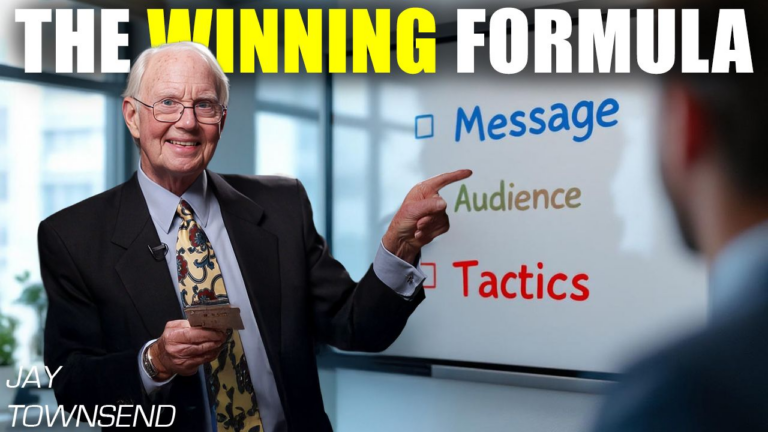
A political campaign strategy is the blueprint for how you’re going to sell a candidate to voters. In this video, political consultant Jay Townsend breaks strategy down into three essential pieces — what you say, who you say it to, and how you get it to them — with real examples from the 2007 Obama campaign to the 2025 New York City mayoral race.
A political campaign strategy is a blueprint for how you’re going to sell a candidate to voters. If you’re a candidate yourself, or working for one who could use some help with this, what you’re about to learn will be invaluable to your campaign. There are three basic things to cover: what you’re going to say to voters, who you’re going to communicate that message to, and how you’re going to disseminate that message. All three are vital components of a political campaign strategy.
The first component of a political strategy is your campaign message, and it has five parts. We’ll start with the most important one: what do voters get by voting for you that they won’t get from anybody else? In politics, you’re a product in the marketplace, only people don’t buy you with money — they buy you with a vote, and that gives you the power to make changes on their behalf. So what are you selling? What will you do that makes their quality of life better? If your offer isn’t a good one, if it isn’t sexy, voters will go look for someone who speaks their language, and it won’t be you.
Second, voters want to know if you’re capable of delivering the goods — do you have the qualifications to actually do the job? Have you done something real in your life that proves you can handle the responsibility that comes with the power you’re asking them to give you? Raising a family, holding a job, winning awards, serving your community, or being deeply passionate about fixing a problem are all things that tell voters: I’ve done this, I can do this job.
Third, voters want to know your values are in sync with theirs. Do you care about the same things they do — the people in your community who need a hand up, the tax bills they pay, the schools they send their kids to? Your moral code has to be on display in your messaging, because if voters get the idea your values are out of sync with theirs, they won’t vote for you no matter what offer you put on the table.
Fourth, voters want to know they can trust you to do the right thing. They’re cynical, because they’ve been promised a lot that’s never been delivered — politicians who talk about everything they’re going to do and then don’t, or who change their mind at the last minute because of political pressure. Tell them something from your own experience that proves you’re sincere about fixing the problem they’re living with, and they’ll trust you to follow through.
Fifth, what makes you better than your opponent? What will you do that they never will? What policy position puts you on the opposite side of the fence from them? What about your past demonstrates a commitment to your community that your opponent has never proven? These five components make up your campaign message — get it right, and you’ll make progress. Get it wrong, and you won’t.
Here’s a fact of political life: not everyone is going to vote for you, especially in these polarized times, with hot-headed people on both sides who think the other side is evil. There’s no point talking to people who will never vote for you — it’s a waste of money and a waste of time. Look for the fruit in your orchard that’s easy to reach. The voters against you are at the top of the tree; there’s no point risking your life on a ladder to pick them. Get the fruit closer to the ground — the voters who can be persuaded, and the voters who will support you if you simply get them to the polls.
One of the best ways to divide the electorate is to look at past voting patterns geographically across your district. That tells you the base vote for the other party, the base vote for your party, and the voters who tend to go back and forth. Understood correctly, that data tells you who’s against you, who could be for you with the right message, and who’s already for you if you can get them to the polls. Every political campaign does this — it’s the basic reason for targeting voters in the first place.
Devote your resources to the people who are persuadable, and find them by digging into your district’s demographics. Is your message more appealing to college graduates than blue-collar workers? Older voters than younger ones? Working-class voters than high earners? Tailor your message accordingly, and use demographic data to find where your sweet spots are.
Once you know what you’re saying and who you’re saying it to, it’s time to talk about how you get it to them. The most basic way candidates have communicated with the electorate since the beginning of time is by giving speeches. Every candidate at some point has to stand up and talk, and a speech done well attracts volunteers and donors. It’s easier than you’d think if you’re passionate about what you’re saying, because passion is magnetic — whether you’re giving a speech, talking on a Zoom call, addressing a town hall, debating an opponent, or speaking to a television camera at a press conference. Be clear and compelling with your words, and it will help you be magnetic and advance your cause.
A story. It was 2007, in the presidential campaign between Barack Obama and Hillary Clinton, at a gathering of 3,000 political activists in a big auditorium in Iowa to hear all the presidential candidates speak. Obama gave the speech of his life that night — no comparison to the others. He walked to the stage, grabbed a microphone, didn’t stand at a podium, didn’t have a script, didn’t even have notes. He just had a conversation, and with the way he spoke to their hopes and dreams — their wish for a better tomorrow, for rural communities that aren’t left behind, for diverse communities living peacefully together, for schools that worked — that night he peeled the paint off the walls. Most of those people went home and told their neighbors, this guy is gold, we have to turn out and vote for him. As a result, Obama won the Iowa caucuses in an upset victory and was on his way to becoming president. That’s the importance of a great speech, and you have that same opportunity every time you address an audience.
There’s a second tried-and-true way to disseminate your message: a ground operation. That’s where volunteers go door-to-door, knock on doors, speak on your behalf, and ask people to vote for you — often with a palm card in hand and something for the voter to sign, whether a petition or a commitment to vote.
Here’s another story, from New York City. A 33-year-old man who was barely on the radar screen five months earlier just won a Democratic nomination for mayor, going from 1% to 40% of the vote in a contest where over a million people voted. What did he have that the better-funded candidates didn’t? He’d spent a lot of time on social media, and people were enthralled by his magnetism and authenticity, so they signed up to volunteer. When they signed up, he gave them something to do — they knocked on hundreds of thousands of doors across New York City. In fact, the portion of the electorate under 45 actually outvoted the older portion, because he spoke to young people and met them where they were, talking about the plight of trying to live in a city where everything costs too much. That’s the power of a ground operation.
That same candidate used social media to get his start — TikTok, YouTube, Facebook, Instagram, Twitter, ubiquitous on all of them, what we call feeding the beast. Social media is a powerful tool, and one of its best uses is candidates being their authentic selves, posting every day about the campaign trail, how they feel about the issues of the day, and the experiences that make them care about the problems concerning people in their city — and that became the source of the volunteers who knocked on all those doors. Part of the trouble with the other candidates is they never posted anything that wasn’t scripted, and did it far less often. He grew his organization and his social media presence by feeding that beast every day, sometimes two or three times a day, which kept his content fresh and made him interesting.
The final way to disseminate your message is paid advertising. Television is available if you can afford it, and even in small jurisdictions, some form of television or digital advertising can reach an audience. Radio is still a good medium in parts of the country with a dominant station. And persuasion mail is almost universal at every level of politics — even U.S. Senate and gubernatorial candidates use it to drive home a message to niche audiences that are part of their winning coalition.
That’s how you put together a campaign strategy: what you say, who you say it to, and how you say it.
Q: What’s the most important part of a campaign message?
A: The single most important question is what voters get by voting for you that they won’t get from anybody else. If your offer isn’t compelling, voters will look elsewhere for someone who speaks their language — so start there before working through the other four components: qualifications, shared values, trustworthiness, and contrast with your opponent.
Q: Should I try to reach every voter in my district?
A: No. In polarized times, a large share of voters will never vote for you no matter what you say, and spending time or money on them is wasted. Focus your resources on persuadable voters and supporters who need to be turned out — the fruit closer to the ground, not the fruit at the top of the tree.
Q: How do I find my persuadable voters?
A: Look at past voting patterns geographically across your district to see the base vote for each party and the voters who swing back and forth. Then dig into demographics — education, age, income, and occupation — to see where your message resonates most, and concentrate your resources there.
Q: What are the main ways to disseminate a campaign message?
A: Three main ways: speeches, which can be magnetic when delivered with genuine passion; ground operations, where volunteers knock on doors and ask people directly for their vote; and paid advertising, including television, radio, digital, and persuasion mail. Social media has also become a powerful way to build the volunteer base that fuels a ground operation.
Q: Can social media really replace big campaign budgets?
A: It can go a long way. In the 2025 New York City mayoral race, a candidate went from 1% to 40% of the vote largely by building an authentic, near-daily social media presence across TikTok, YouTube, Facebook, Instagram, and Twitter, which turned into an army of volunteers knocking on hundreds of thousands of doors — proof that consistency and authenticity can outperform a bigger budget.
Jay Townsend has spent more than 40 years advising candidates at every level of American politics on exactly this kind of strategy. Jay sets aside time each week to speak with prospective candidates, so click the link in the video description to get in touch. Browse the full resource library at JayTownsend.com or subscribe to Jay’s YouTube channel for new campaign strategy videos every week.
Copyright @ 2026 jaytownsend.com, All Rights Reserved.