
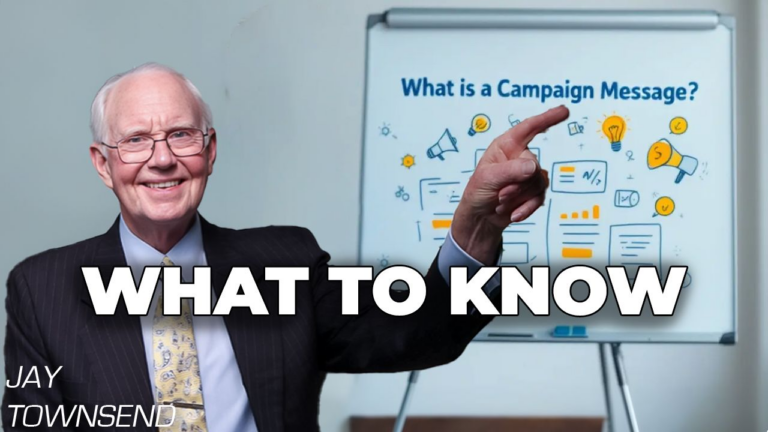
A campaign message is what you’re going to do for voters if you get the job — but figuring out exactly what that is trips up more candidates than any other part of the campaign. In this video, political consultant Jay Townsend covers the five questions every voter expects you to answer, then does a deep dive into finding real, substantive answers to the hardest one: what are you going to do for me?
A campaign message is what you’re going to do for voters if you get the job. It’s what you’re going to do with the power that comes with the office, and how you’re going to elevate their quality of life and make things better for at least some people in your jurisdiction. That’s the short answer — here’s the longer one.
There are five questions voters expect you to answer during the course of a campaign. They want to know what you’re going to do for them. They want to know what makes you qualified. They want to know a little about your values and moral code, to be sure yours are in sync with theirs. They want you to explain why they should trust you to do the job. And by the end of the campaign, they want to know what makes you better than your opponent.
The one candidates often find hardest to answer is what are you going to do for the voters. Some candidates come to me with a list of 50 things they want to do. Others are fuzzy — they want to help the homeless, or they think schools need more support, but they’re not exactly clear on what they’d actually do. So here are five sources of ideas you can pursue to enrich your own list.
The first place to look is your own head. If you read, if you’ve been involved in your community, if you’ve been paying attention to what’s going on in the world, you probably already have a list of things you’d like to fix if only you had the power to fix them. Start making this list — it may be three ideas, five, or twenty-five.
If you’re still not satisfied that your list reflects things that really matter to voters, for a single week make it a habit to get up half an hour early and glance at the headlines of certain newspapers. If you’re running for Congress, check the New York Times and the Wall Street Journal. If you’re running for statewide office, look at your statewide newspaper that covers politics. If you’re running in a smaller community, look at your local paper, blogs, or electronic newsletters. Headlines aren’t just clickbait — they’re about problems, and newspapers cover problems. That makes them a great source of ideas for problems you’d like to solve.
Get a car and drive around your jurisdiction — every road, every street, every alley, every back road, every gravel road — and take a look at what you see. Better yet, have someone else drive so you can sit in the passenger seat and take notes. I once had a client running for City Council in New York who was having trouble coming up with ideas, so I gave him this assignment. He called me the following Monday after spending the weekend driving every street in his district and said, Jay, I’ve got 50 ideas — dangerous intersections with traffic lights that don’t work, subway stops where the lights go out at night, parks with garbage, a park with no night light that felt dangerous to be around. He was excited, and he found all of it simply by driving around and looking closely at every neighborhood.
Make a list of four, five, or six of the smartest, most well-informed people you know. Invite them over on a Saturday afternoon, feed them pizza, break out the beer or the Pepsi, and hold a round-table discussion. Ask each one: if you held public office and had a magic wand to fix three major problems, what would you fix, and how would you do it? If you’ve got smart people in the room, you’ll be surprised what you hear, and you may come away with additional ideas to promote in your own campaign.
Every community has civic and community leaders who serve people who need a hand up. If you want to know about problems in your community, sit down with the president of a service club, the president of United Way, the president of the Chamber of Commerce, or the president of a cause-driven organization, and ask them what they see. Do all five of these things, and you won’t end up with just two or three ideas — you’ll have pages of problems that could and should be fixed, and ideas for how to fix them, which will make your campaign message a whole lot richer than it might otherwise be.
Q: What is a campaign message, in simple terms?
A: It’s what you’re going to do for voters if you get the job — how you’ll use the power of the office to elevate their quality of life and make things better for at least some people in your jurisdiction.
Q: What are the five questions voters expect a candidate to answer?
A: What are you going to do for them, what makes you qualified, whether your values and moral code are in sync with theirs, why they should trust you to do the job, and what makes you better than your opponent.
Q: Why do so many candidates struggle to answer “what are you going to do for voters”?
A: Some candidates show up with a list of 50 things they want to do, while others are fuzzy, offering only vague ideas like “help the homeless” or “support schools” without specifics. Either way, a real answer takes deliberate work to find, which is why it’s worth pursuing multiple sources of ideas rather than relying on instinct alone.
Q: Where should I look for real, substantive campaign ideas?
A: Start with what’s already in your head from paying attention to your community, then spend a week reading the newspapers or local outlets that cover your jurisdiction, drive every street in your district and take notes on what you see, host a round-table with the smartest people you know, and sit down with civic and community leaders who serve people who need a hand up.
Q: What’s a good example of finding ideas by driving your district?
A: A City Council candidate in New York spent a weekend driving every street in his district and came back with 50 ideas — broken traffic lights, subway stops with burned-out lights, parks with garbage or no night lighting. Simply looking closely at every neighborhood turned up more real problems than he could have found any other way.
Jay Townsend has spent more than 40 years helping candidates find and shape the ideas that become winning campaign messages. Browse the full resource library at JayTownsend.com or subscribe to Jay’s YouTube channel for new campaign strategy videos every week.
Copyright @ 2026 jaytownsend.com, All Rights Reserved.